The Killing Season by Robinson Geoffrey
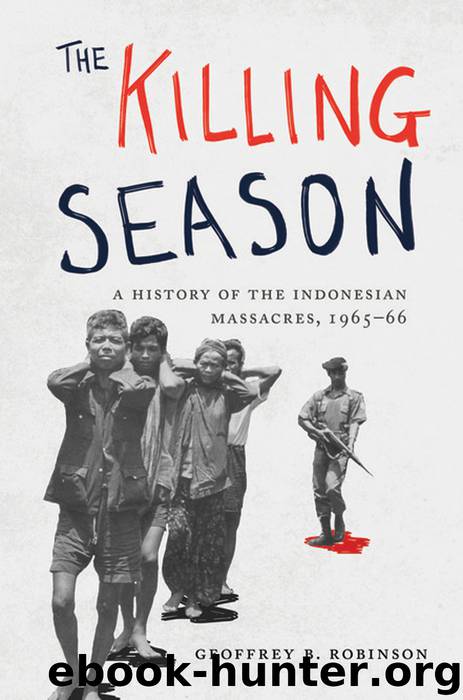
Author:Robinson, Geoffrey
Language: eng
Format: epub
Publisher: Princeton University Press
Published: 2018-03-18T04:00:00+00:00
Buru: Prison Island
In 1969, some twenty-five hundred category B political detainees were secretly transported by train and then ship from their prisons in Java to the tiny island of Buru, in the far eastern reaches of Indonesia’s vast archipelago. There, with only the most basic tools and materials, and under constant guard by heavily armed soldiers, they began to build the barracks, roads, staff headquarters, fences, and guardhouses of what would eventually become one of the largest and most notorious concentration camps in Asia.83
Over the next few years, this first group was joined by successive waves of category B detainees, until by 1975 the total number held on Buru Island was at least ten thousand.84 Except for the hundreds who died there due to starvation, suicide, and disease, all these prisoners remained on Buru until the late 1970s. The last of the prisoners were finally returned to Java in late 1979, a full ten years after the first boatload had arrived. None of those held in the camp were ever charged with a crime. Nor was any plausible reason ever given for their eventual release.
When Indonesian Army authorities acknowledged the existence of the camp in late 1969, they insisted that it was not a concentration camp. It was, they said, a resettlement project that would provide “settlers” the chance to be productive citizens, developing a remote part of the country, while at the same time undergoing political “rehabilitation.” Formally coordinated by the prosecutor general, Buru was in reality a penal colony run and controlled by the army, and more specifically the powerful Kopkamtib.85 Everything about Buru—from the geographic layout of its barracks and yards, to the treatment of the so-called settlers, and the language used to rationalize it—bore the army’s distinctive imprint. That military ethos was made apparent in one of President Suharto’s first public comments about Buru in December 1969: “Some elements of the foreign press have tried to discredit Buru as an Indonesian version of [the Dutch colonial place of exile] Boven Digul or a concentration camp. They forget that in history, war always brings risks for the losing side.”86 The detainees, then, were seen as the defeated enemies in a war.
Indeed, while some observers and former prisoners sought to draw parallels between Buru and the places of exile to which the Dutch colonial authorities had sent their most troublesome political opponents, Buru was actually quite different and, in reality, worse. The more fitting comparison was with the POW camps that the Japanese military authorities had set up in Indonesia and elsewhere during the Second World War.87 As in those camps, the inmates on Buru were made to work under military guard from morning to night, building barracks and staff quarters, roads and walkways, and turning dense jungle and grasslands into farmland. Like the POWs in the Japanese camps, the Buru internees received only the barest ration of food, which they had to supplement to stay alive; slept in barracks with virtually no amenities; suffered illness for which
Download
This site does not store any files on its server. We only index and link to content provided by other sites. Please contact the content providers to delete copyright contents if any and email us, we'll remove relevant links or contents immediately.
The Vikings: Conquering England, France, and Ireland by Wernick Robert(84227)
Ali Pasha, Lion of Ioannina by Eugenia Russell & Eugenia Russell(40255)
The Conquerors (The Winning of America Series Book 3) by Eckert Allan W(37473)
The Vikings: Discoverers of a New World by Wernick Robert(36978)
Cecilia; Or, Memoirs of an Heiress — Volume 1 by Fanny Burney(32558)
Cecilia; Or, Memoirs of an Heiress — Volume 2 by Fanny Burney(31956)
Cecilia; Or, Memoirs of an Heiress — Volume 3 by Fanny Burney(31940)
Empire of the Sikhs by Patwant Singh(23083)
The Secret History by Donna Tartt(19082)
Hans Sturm: A Soldier's Odyssey on the Eastern Front by Gordon Williamson(18589)
Cat's cradle by Kurt Vonnegut(15351)
Pimp by Iceberg Slim(14506)
Sapiens: A Brief History of Humankind by Yuval Noah Harari(14389)
Talking to Strangers by Malcolm Gladwell(13370)
Norse Mythology by Gaiman Neil(13363)
Leonardo da Vinci by Walter Isaacson(13336)
4 3 2 1: A Novel by Paul Auster(12390)
Underground: A Human History of the Worlds Beneath Our Feet by Will Hunt(12097)
The Radium Girls by Kate Moore(12026)
